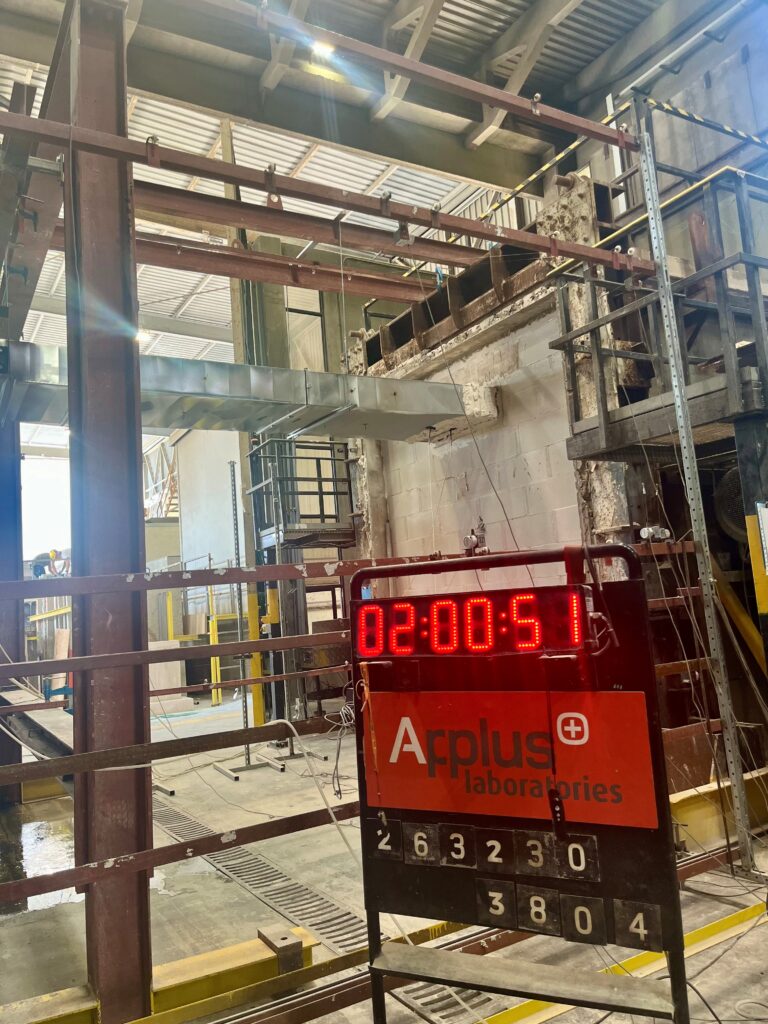
We assign property assignments of 2 E-600 tests for sections up to 1250 × 1000, another one up to 1550×600 and also one up to 2000×600
We are pleased to share some very important news:
As of July 1, 2026, we have obtained the “S” classification for the E-600/120 test regarding vertical and horizontal smoke extraction ducts
Regulations governing the installation of smoke extraction ducts changed in 2025. Previously, tests conducted on horizontal ducts were accepted for vertical installations as well.
Now, however, vertical ducts require a new test—conducted after the regulation came into effect—that expressly permits installation in both horizontal and vertical positions.
Obtaining the “S” classification allows us to utilize this test result and, consequently, to supply and install ducts in European countries where this standard is required. The “S” level indicates a leakage rate of less than 5 m³/h/m², a standard we achieved while maintaining our usual simplified sealing methods.
Finally, if you are interested in obtaining full rights to use this test result, please let us know so we can begin the standard procedures with which you are already familiar from our previous five tests.
We assign property assignments of 2 E-600 tests for sections up to 1250 × 1000, another one up to 1550×600 and also one up to 2000×600
We have 4 E-600 test reports available for full ownership transfer:
Using RAMI 20 mm flanges for horizontally mounted rectangular ducts with cross-sections up to 1250×1000; based on a new test conducted at APPLUS in 2020. Features 0.8 mm thick sheet metal for both the duct and the RAMI 20-D flanges, and meets the minimum CLASS-A airtightness requirement (sealing only 4 cm of the interior at each corner).
Using RAMI 20 mm flanges for horizontally mounted rectangular ducts with cross-sections up to 1250×1000; based on a new test conducted at APPLUS in 2022. Features 0.6 mm thick sheet metal for the duct and 0.5 mm thick RAMI 20-A flanges, and meets the minimum CLASS-A airtightness requirement (sealing only 4 cm of the interior at each corner).
Using RAMI 20 mm flanges for vertically and horizontally mounted rectangular ducts with cross-sections up to 1250×1000; based on a new test conducted at APPLUS in 2026. Features 0.8 mm thick sheet metal for the duct and 0.5 mm thick RAMI 20-A flanges, an “S” test classification, and meets the minimum CLASS-A airtightness requirement (sealing only 4 cm of the interior at each corner).
Using RAMI 30 mm flanges for horizontally mounted rectangular ducts with cross-sections up to 1550×600; based on a test conducted at APPLUS in 2011. Using 1 mm thick sheet metal for the duct and 0.6 mm thick RAMI 30-A flanges, meeting the minimum Class A airtightness requirement (sealing only 4 cm of the interior at each corner).
Using 30 mm RAMI flanges for horizontally installed rectangular ducts with cross-sections up to 2000×600, based on testing conducted by APPLUS in 2011. Using 1 mm thick sheet metal for the duct and 0.9 mm thick RAMI 30-B flanges, meeting the minimum Class A airtightness requirement (sealing only 4 cm of the interior at each corner).
Para ofrecer las mejores experiencias, utilizamos tecnologías como las cookies para almacenar y/o acceder a la información del dispositivo. El consentimiento de estas tecnologías nos permitirá procesar datos como el comportamiento de navegación o las identificaciones únicas en este sitio. No consentir o retirar el consentimiento, puede afectar negativamente a ciertas características y funciones.
Funcional
Always active
El almacenamiento o acceso técnico es estrictamente necesario para el propósito legítimo de permitir el uso de un servicio específico explícitamente solicitado por el abonado o usuario, o con el único propósito de llevar a cabo la transmisión de una comunicación a través de una red de comunicaciones electrónicas.
Preferencias
El almacenamiento o acceso técnico es necesario para la finalidad legítima de almacenar preferencias no solicitadas por el abonado o usuario.
Estadísticas
El almacenamiento o acceso técnico que es utilizado exclusivamente con fines estadísticos.El almacenamiento o acceso técnico que se utiliza exclusivamente con fines estadísticos anónimos. Sin un requerimiento, el cumplimiento voluntario por parte de tu proveedor de servicios de Internet, o los registros adicionales de un tercero, la información almacenada o recuperada sólo para este propósito no se puede utilizar para identificarte.
Marketing
El almacenamiento o acceso técnico es necesario para crear perfiles de usuario para enviar publicidad, o para rastrear al usuario en una web o en varias web con fines de marketing similares.